


TM
Larsonite aka Gary Green Jasper
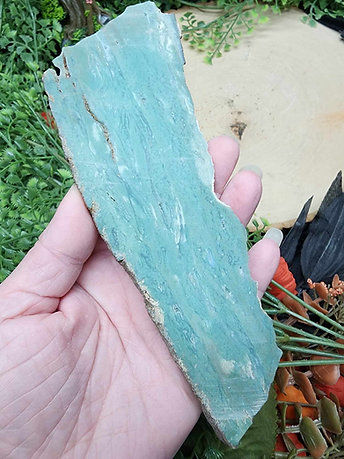
Larsonite, better known throughout the lapidary world as Gary Green Jasper, is a rare silicified material from the McDermitt area along the Oregon and Nevada border. It is also encountered under names including McDermitt Jasper, Gary Green, and Gary Green Petrified Bogwood. Larsonite is a locality specific lapidary name rather than a formally recognized mineral species, and its exact geological classification has been debated. For decades it was widely described as petrified bogwood, originating from vegetation and organic material buried within an ancient wetland environment during the Miocene Epoch. Volcanic activity in the region deposited enormous amounts of ash and silica rich material, while mineral rich fluids circulated through the sediments. Over time silica replaced or permeated portions of the buried material, creating the dense material collected today. More recent interpretations suggest that at least some Larsonite may be better described as silicified volcanic or tuffaceous sediment associated with geothermal activity rather than literal petrified wood. Different portions of the deposit may also represent slightly different materials. What is certain is that authentic Larsonite is tied specifically to the McDermitt region and its complex volcanic history.
Classic Larsonite ranges from soft sage and olive green to vivid green, teal, turquoise blue, cream, tan, brown, rusty red, pink, and occasional orange. Some pieces are almost entirely green while others contain flowing blue green areas surrounded by earthy browns, creams, and reds. Its patterns can resemble wood grain, moss, wetlands, tree bark, rivers, distant landscapes, or abstract paintings. The material is silica rich and capable of taking an excellent polish, making it highly desirable for cabochons, slabs, spheres, palm stones, carvings, and collector pieces. Gary Green is not simply a name for any green Jasper. Authentic material is associated with this specific locality, making provenance particularly important when purchasing older or higher quality specimens.
The history of the name is almost as complicated as the geology. Gary Green Jasper and Larsonite have been associated with Gary McIntosh and Ray Larson, early miners connected with the material, and multiple names entered the lapidary trade as different people worked and sold material from the area. That history helps explain why research can produce conflicting descriptions. One source may call it petrified wood, another Jasper, another silicified sediment, and another geothermal material. Rather than forcing Larsonite into a perfectly neat category, it is better understood as a distinctive silicified lapidary material from a geologically complicated volcanic region whose formation has been interpreted differently over time.
Larsonite has also become increasingly collectible because the classic material is finite and older stock can be extremely difficult to replace. Particularly desirable pieces display vivid green or blue green coloration, unusual contrasting patterns, strong polish, or documented provenance. There have been reports of additional material being recovered from the broader deposit in more recent years, so claims that absolutely no Larsonite remains underground should be treated carefully. What is true is that genuine material comes from a very limited locality, exceptional old stock is increasingly scarce, and this is nothing like Amethyst or Quartz where enormous deposits occur across the world. When a particularly beautiful piece of Larsonite is gone, finding another that looks exactly like it may be impossible.
Metaphysically, Larsonite carries a deeply earthy energy centered around grounding, resilience, emotional healing, patience, ancient memory, and connection to the natural world. It is especially useful during periods when life feels unstable or scattered and you need to get your feet underneath you again. Larsonite does not have a frantic energy. It encourages slowing down enough to recognize what actually requires your attention instead of exhausting yourself trying to control everything at once.
Its green coloration naturally connects Larsonite with the Heart Chakra, growth, renewal, abundance, compassion, and emotional balance. Unlike softer Heart Chakra stones that are often centered around romance and comfort, Larsonite feels more suited to mature emotional work. Grief, forgiveness, boundaries, self respect, acceptance, and recognizing unhealthy emotional patterns all fit comfortably within its energy. It encourages compassion without requiring self sacrifice and forgiveness without pretending something harmful never happened.
Larsonite is particularly useful when examining emotional patterns that have been carried for years. Its ancient origins make it a natural companion for shadow work involving memories, family dynamics, learned behaviors, inherited beliefs, and survival mechanisms that continue operating long after the original circumstances have disappeared. Rather than endlessly digging through old wounds, Larsonite encourages looking at what those experiences created. The important question becomes whether an old response is still protecting you or simply repeating itself because it has become familiar.
This makes Larsonite especially useful for breaking cycles. It can be worked with when examining repeated relationship patterns, fear surrounding money, difficulty setting boundaries, people pleasing, avoidance, self sabotage, or beliefs inherited from family and environment. There is a strong sense of roots with this material, but roots are not the same thing as chains. Larsonite can represent understanding where something began while recognizing that its origin does not determine where it has to end.
Its connection with the Heart Chakra also makes Larsonite a beautiful companion for grief work. Grief rarely moves in a straight line, and the flowing patterns within the stone reflect that beautifully. Some days feel peaceful while others unexpectedly reopen emotions you thought had already settled. Larsonite can represent carrying memory without allowing grief to become the only thing you carry. Moving forward does not require forgetting, and healing does not require pretending the loss no longer matters.
The blue and teal areas found in many specimens add a strong Throat Chakra correspondence. This brings communication, honesty, truth, and self expression into Larsonite's otherwise earthy nature. Pieces containing significant blue green coloration are especially appropriate when emotional healing requires saying something that has remained buried. This can mean setting a boundary, asking for what you need, admitting something to yourself, speaking about an experience, or finally having the conversation you have rehearsed in your head a hundred times.
The combination of green and blue makes Larsonite particularly useful for connecting the Heart and Throat Chakras. It encourages speaking from emotional truth without allowing emotion to completely control the conversation. This makes it an excellent stone for learning the difference between keeping the peace and actually creating peace. Sometimes harmony requires an uncomfortable conversation. Sometimes compassion requires a firm no. Sometimes loving another person and protecting yourself need to exist at the same time.
Larsonite is also strongly connected with grounding and Earth magic. Its colors evoke forests, moss, wetlands, soil, old trees, riverbeds, and weathered landscapes. It works beautifully in nature based spiritual practice, garden magic, seasonal rituals, land connection, ancestor work, and meditation outdoors. It can be placed on an altar to represent Earth, carried while hiking or exploring natural spaces, or used when developing a stronger spiritual relationship with the land around you.
Its ancient geological origins also make Larsonite particularly suited to ancestor work and contemplation of deep time. Holding something that began forming millions of years before any living human existed puts our own lives into a completely different perspective. The problem consuming your entire world today exists inside a much larger story. Larsonite can be used when you need perspective without dismissing the importance of what you are experiencing.
That sense of deep time gives Larsonite a strong correspondence with patience. This is not passive patience or waiting for the universe to magically fix things. It is the patience required to build something worthwhile. Businesses take time to grow. Skills require practice. Trust must be earned. Gardens need seasons. Spiritual practices deepen through repetition. Larsonite is an excellent stone for long term goals because its energy favors consistency over dramatic bursts of effort followed by exhaustion.
Resilience is another major correspondence. Larsonite can be carried during difficult periods as a reminder that resilience does not always mean standing perfectly still while everything hits you. Sometimes strength is persistence, sometimes it is adaptation, and sometimes it is knowing when something has reached its natural end. Its energy is particularly suited to recovering your footing after upheaval and finding enough stability to determine what comes next.
For prosperity work, Larsonite is best suited to abundance that grows from strong foundations. Its green coloration naturally lends itself to money and prosperity magic, while its grounding nature makes it especially appropriate for business stability, career development, savings, property, land, creative ventures, and sustainable financial growth. This is not lottery ticket energy. Larsonite belongs beside the business plan, savings goal, long term project, garden, or investment in your craft. It supports the kind of abundance you build and maintain.
Larsonite also carries a strong energy of personal sovereignty. It is useful for confidence, boundaries, independence, self respect, and releasing the constant need for outside approval. Its strength is quiet rather than aggressive. It does not feel like kicking down every door simply because the door exists. It is knowing which doors are worth opening and no longer wasting your energy standing outside the ones that were never meant for you.
In meditation, Larsonite can be used for grounding, ancestor work, emotional exploration, reflection, and connecting with nature. Its patterns make it especially good for visual meditation. Choose a line, patch of color, or unusual formation within the stone and simply follow it with your eyes. Landscapes, faces, forests, rivers, animals, and other shapes may begin to emerge as the mind recognizes patterns. These impressions can become useful starting points for journaling, intuitive work, divination, or exploring subconscious associations.
Larsonite can also serve as a stone of remembrance. Older pieces with known provenance carry both geological history and a piece of modern lapidary history. Because high quality material cannot simply be manufactured or endlessly replaced, a beautiful specimen can become an heirloom, altar stone, meditation companion, or collector piece that remains with someone for decades. There is something fitting about allowing a material millions of years old to become part of your own much shorter story.
Elementally, Larsonite is strongly connected with Earth, with Water serving as a natural secondary correspondence because of its traditional association with an ancient wetland environment and the flowing green and blue patterns found in many specimens. Earth represents grounding, stability, patience, prosperity, growth, and physical connection, while Water brings emotion, intuition, memory, healing, and adaptability. Together they give Larsonite an energy that feels rooted without becoming stagnant.
Larsonite is especially suited to intentions involving grounding, resilience, emotional healing, ancestral connection, boundaries, self respect, patience, prosperity, communication, grief work, shadow work, nature connection, stability, renewal, and long term manifestation. It can be carried, placed on an altar, used in crystal grids, kept in a workspace, held during meditation, incorporated into ancestor practice, or simply displayed as the rare and fascinating piece of geological history that it is.
There is something particularly special about Larsonite because its story is not perfectly tidy. Its geology has been debated, its names have changed, its availability has fluctuated, and the best old material becomes harder to replace as collections absorb it. What remains unmistakable is the stone itself. Earthy, strange, ancient, and immediately recognizable, Larsonite carries the colors of forest, water, soil, and weathered land in a material tied to one remarkable corner of the American West. For collectors and spiritual practitioners alike, that combination of beauty, history, locality, and scarcity is exactly what makes genuine Gary Green so damn special.